
Windrow vs. Bale Moisture Testing: When Should You Test?

Test the windrow to decide when to start baling. Test finished bales to decide whether they are safe to stack. These two hay moisture tests answer different questions, so a careful producer does both. If you only have time for one, test the windrow, because that is the last point where a wet field costs you nothing but time.
This guide covers what each test tells you, which probe to use, and which reading to trust when the two disagree.
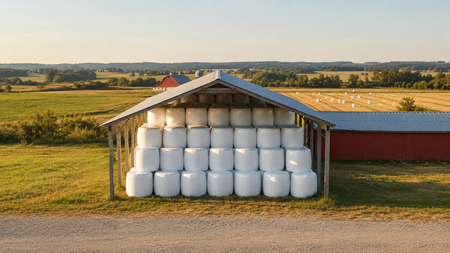
Photo by Randy Fath on Unsplash

In Brief
- Windrow test: tells you when to start baling.
- Baler sensor: shows moisture as each bale forms (optional).
- Bale test: tells you whether bales are safe to stack.
- Stack check: temperature, 4 to 5 days after baling.
- If two readings disagree, act on the higher one.
Why Moisture Differs From Stage to Stage
Hay is not the same at every stage. In the windrow it is loose and exposed to sun, wind and dew. In the bale it is dense and closed off from the air.
Extension specialists from the University of Idaho note that moisture is not uniform in windrows, bales or stacks. They also report that hay can gain or lose 3 to 5 percentage points of moisture in an hour, and that one windrow can vary by 10 points. A single reading cannot cover that.
Testing in the Windrow
A windrow test tells you whether the swath is dry enough to bale. It is the cheapest place to catch a wet field.
- Test before raking or tedding, then again before baling.
- Look for the wettest hay. The Idaho guide says the wettest sample usually sits underneath the windrow.
- Take many samples. The guide recommends 12 to 20 random samples, with 12 enough for evenly dry hay and 20 for variable conditions.
- Watch for dew. Dew on the surface makes a probe overestimate moisture, so a reading taken early in the day can look wetter than the hay really is.
Loose hay also makes poor contact with a probe. The Idaho guide recommends a windrow sampling tool that compacts the sample the way a bale does, and many producers pack hay into a bucket for the same reason.
Testing During Baling
Baler-mounted sensors read moisture as hay enters the bale chamber, so you see a wet patch without stopping. The Idaho guide says these chamber-mounted testers are close to standard on large rectangular balers and are available for round and small balers.
Some preservative applicators use the same kind of sensor to adjust the application rate as moisture changes. If you run an applicator, see our forage applicators, parts and accessories.
Testing Finished Bales
A bale test tells you whether a bale is safe to stack. A short pin only reads the surface, so use a long probe that reaches into the bale.
The Idaho guide says to push the probe in at least 12 inches and take readings in at least twenty random spots for each 200 tons of hay. Bale density also affects meter accuracy, so compare bales of similar density. Our Koster Bale & Soil Probe 36" is one option for reaching deep into a bale, and you can browse all of our hay probes and moisture testers for tools that reach the core.

Windrow vs. Bale Testing at a Glance
| Stage | What it tells you | Probe or tool | Watch out for |
|---|---|---|---|
| Windrow | When to start baling | Probe or sampling tool that makes good contact with loose hay | Readings vary across the swath, and dew can inflate them |
| In the baler | Moisture as the bale forms | Baler-mounted sensor | Needs a sensor installed on the baler |
| Finished bale | Whether the bale is safe to stack | Long probe that reaches the core | Bale density changes readings, so test many spots |
| Stack, days later | Whether bales are heating | Thermometer | Heat peaks 3 to 7 days after baling |
An electronic probe is an estimate, not a measurement. The Idaho guide puts the typical error at about 5 percentage points, compared with about 1 point for convection oven drying. Treat each reading as a range and take plenty of them.
Which Reading to Trust When They Disagree
Windrow and bale readings often differ. The windrow is loose and may carry dew. The bale is dense and may have dried or sweated since you measured it. Because a meter is an estimate, act on the higher number when fire risk is involved.
- Windrow reads above target: wait and retest.
- Bale reads above target: do not stack it. Leave bales spread out and check temperature 4 to 5 days after baling. Alberta Agriculture says hay should ideally stay unstacked for the first three weeks, and its heated bales guide explains how to read bale temperature.
- Both read at target but the temperature climbs: trust the thermometer. Our guide to the signs your hay was baled too wet shows what else to look for.
A Simple Testing Schedule
- Before raking or tedding: check the swath.
- Before baling: test the windrow in 12 to 20 spots.
- During baling: watch the baler sensor if you have one.
- After baling: test bales before stacking, in about twenty spots for each 200 tons.
- On days 4 to 5: check bale temperature.
For safe moisture targets by bale type, see our guide on how to test hay moisture before baling.
FAQ
Should I test hay moisture in the windrow or in the bale?
Both. The windrow test tells you when to bale. The bale test tells you whether to stack.
How accurate is a hay moisture meter?
Accurate enough to guide decisions, but not exact. The Idaho guide puts the typical error for an electronic probe at about 5 percentage points, so treat each reading as a range and take many readings.
Do I need a different probe for the windrow and the bale?
Usually yes. Loose hay needs a probe or sampling method that makes good contact, while bales need a long probe that reaches the core. Check which probes your meter accepts, then browse our hay testing collection. Probe tips wear with use, so we also carry a replacement tip kit for Koster bale probes.

How many readings should I take?
More than most people expect. The Idaho guide recommends 12 to 20 random samples across a field, and about twenty readings for each 200 tons of baled hay.
What is the best time of day to test?
After the dew has burned off. The Idaho guide says dew is usually gone after a few hours of sun or a light breeze, and while it lasts it makes meters read too wet.
In Summary
Test the windrow to time your baling, test the bales to decide whether to stack, and check temperature a few days later. Next, read How to Test Hay Moisture Before Baling (And Why It Matters) and Signs Your Hay Was Baled Too Wet (And How to Prevent It Next Season). To find probes and testers, browse our Hay Testing collection or call our team in Mountain View County.
Recent articles
View all