Baled Silage vs. Bunker Silage: Which Storage Method Fits Your Farm?
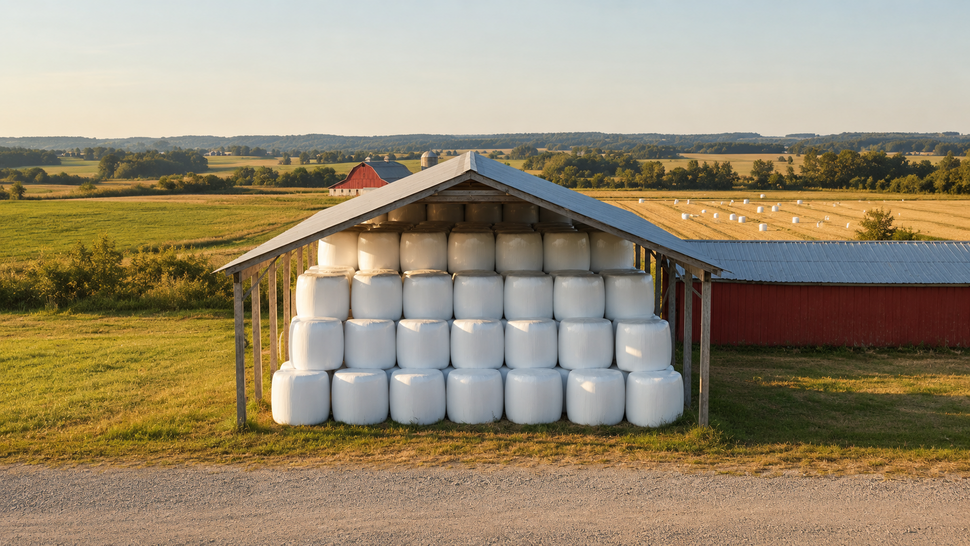
There are two common ways to put up forage as silage: wrap it as individual bales (baled silage, or baleage) or pack it into a bunker or pile. Both work by the same principle — squeeze out the oxygen so the crop ferments and keeps — but they differ a lot in cost, labour, storage loss, and how much flexibility you get. Here's how to weigh them for your operation.
How each method works
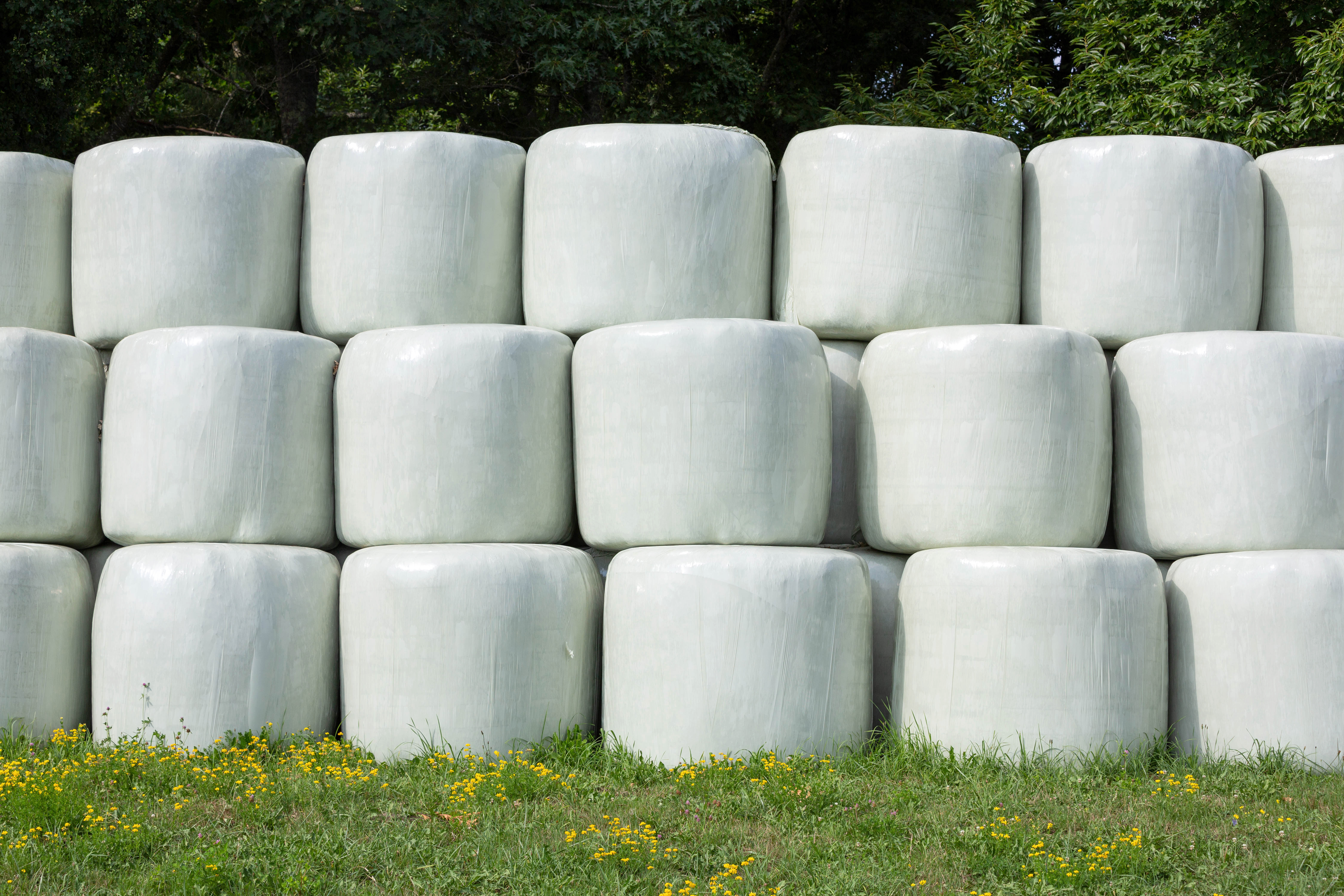
With baled silage, you cut and wilt the crop, bale it wetter than dry hay, and wrap each bale in stretch film to seal it. Fermentation happens inside each sealed bale. With a bunker or pile, you chop the crop, build it up in a pit or on a pad, pack it hard with a tractor to drive out air, and seal the whole mass under a tarp or cover. Either way, the goal is the same: get the air out fast and keep it out.
Storage loss and the packing factor
A bunker lives or dies by packing density. The target is roughly 16 lb of dry matter per cubic foot, and getting there directly controls how much feed you lose. Classic Cornell data shows dry-matter loss dropping from about 10% at a loose 10 lb/ft³ down to roughly 3–5% once you reach 18–20 lb/ft³. Hitting that density takes a heavy tractor kept constantly on the pile, a steady even fill, and extra attention to the top and sides where density tends to run lowest.
Baled silage spreads the risk differently. Each bale is sealed on its own, so a torn wrap or a spoiled patch costs you one bale, not the exposed face of an entire bunker. The trade-off is that every bale depends on its wrap staying intact — which is why film quality and full coverage matter so much with baleage, and why a punctured bale caught early is worth patching before mould takes hold.
Fermentation and forage quality
Both systems rely on the same fermentation, and both stabilise in roughly three weeks once sealed. The difference is how forgiving they are. In a bunker, a slow fill, a loosely packed pile, or an exposed face lets oxygen keep feeding the crop — silage running more than about 6°C above the outside temperature is a red flag that it's heating and losing nutrients. Baleage sidesteps some of that by sealing each bale immediately, but it has its own limit: a bale wrapped too wet can push into butyric (clostridial) fermentation, which smells sharp and drops palatability. Getting the crop into the right moisture window and sealing it fast is the shared key to quality either way.
Moisture targets
The two systems want the crop at different moistures. Bunkers and piles are typically filled around 65–70% moisture so the material packs tight. Baled silage is usually wilted drier — commonly in the range that lets it bale and wrap well without slumping — because a bale that goes up too wet invites that butyric fermentation. Testing moisture before you bale or fill is the single biggest quality lever either way, and it's cheap insurance against a whole season's forage going off.
Cost, labour, and scale
A bunker carries higher fixed costs — a pad or walls, a big packing tractor, and a crew at fill time — but once it's running, the cost per ton is low and feed-out is fast. That makes it the efficient choice for large operations feeding a lot of silage every day. A baled system has a much lower cost of entry: no permanent structure, work you can spread out over days, and batch sizes you control. The offset is more plastic per ton and more wrapping time — plus more used wrap to manage and recycle afterward.
Labour looks different too. A bunker concentrates the work into a short, intense fill window where you need choppers, trucks, and a packing tractor all running at once — miss the crew or the weather and quality suffers. Baleage lets one person bale and wrap as the field dries, spreading the same job across days and smaller windows. For an operation that's short on people or juggling several fields, that flexibility can matter more than the per-ton cost.

Feed-out and flexibility
Feed-out is where herd size really decides it. A bunker needs enough animals to move across the open face quickly; if you feed too slowly, the exposed face heats and spoils. Baled silage lets you open one bale at a time, which suits smaller herds, multiple feeding groups, or forage you plan to sell or move. Bales are also easy to haul and trade — a bunker is not — so baleage doubles as a way to make forage you can sell off the yard.
Which fits your farm?
If you're a large dairy or feedlot feeding silage daily and can justify the structure and the packing horsepower, a bunker usually wins on cost per ton. If you're smaller or mixed, want flexible batch sizes, are short on capital or labour, or make forage to sell, baled silage gives you flexibility a bunker can't. Plenty of Alberta operations run both — a bunker for the daily ration and baleage for odd fields, surplus cuts, or custom work.
FAQ
Is baled silage cheaper than a bunker?
It has a much lower cost of entry — no permanent structure or packing tractor — but a higher cost per ton because of the plastic and wrapping time. Bunkers reverse that: higher fixed cost, lower cost per ton at volume.
Which method loses less feed?
A well-packed bunker (18–20 lb DM/ft³) can hold dry-matter loss to roughly 3–5%, but a poorly packed one loses far more. Baled silage limits any single failure to one bale rather than a whole face.
What moisture should each be made at?
Bunkers and piles are typically filled around 65–70% moisture; baled silage is usually wilted drier so it bales and wraps cleanly. Always test before baling or filling.
How long until silage is ready to feed?
Both baleage and bunker silage stabilise in about three weeks once sealed, provided air is kept out.
Can I do both on one farm?
Yes — many producers run a bunker for daily feeding and use baleage for smaller fields, surplus, or forage they intend to sell.
Whichever way you store it, West Country Dairy Supply carries the supplies to seal it right — silage bale wrapping film for baleage and bunker & pile covers for pits and piles — with shipping across Alberta and Canada.
Recent articles
View all
What Is Silage Wrap Made Of? A Guide to Film Types & Thickness
Silage Wrap Recycling in Alberta: What Farmers Need to Know