Signs Your Hay Was Baled Too Wet (And How to Prevent It Next Season)

The main signs your hay was baled too wet are heat, a smell, a colour change and mould. Bales that feel warm, smell like tobacco, caramel or smoke, or give off steam have wet hay inside. Heating usually peaks 3 to 7 days after baling, so the signs show up early.
This guide shows what each sign means, what to do with the hay, and how to stop it happening next season.
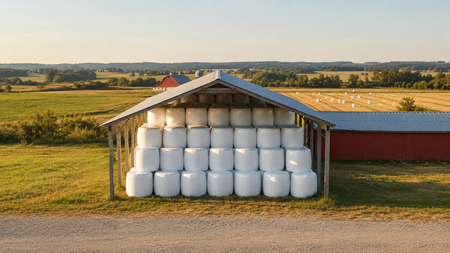
Photo by Max Tcvetkov on Unsplash

In Brief
- Heat, smell, steam, sagging bales and mould are the main warning signs.
- A warm bale is normal at first. A bale that does not cool after its first heating cycle is a fire risk.
- Call the fire department at 175°F (80°C). At 195°F (90.5°C) or hotter, do not move the hay without their help.
- Mouldy hay is a bigger risk for horses and pregnant animals than for other cattle.
- Prevention starts before the baler: test, bale at your target, and keep new bales unstacked for three weeks.
Signs Your Hay Was Baled Too Wet
| Sign | What it means | What to do |
|---|---|---|
| Warm or hot bales | Microbes are heating the hay. Alberta Agriculture says bales normally stay below 130°F (54°C). | Measure the temperature in the tightest part of the bale. |
| Caramel or tobacco smell, golden or brown colour | Heat has damaged protein, so the hay is less digestible. | Send a sample for a feed test and ask for a heat damaged protein test. |
| Strong burning smell or visible steam | The hay is heating hard. Extension specialists at North Dakota State list these as signs of heating. | Check the temperature now, and every day if it keeps rising. |
| Musty smell, dust or visible mould | Mould is growing. A mouldy or "mousey" smell, or dust that lifts when you disturb the hay, is a warning. | Do not feed it to horses. Test it before feeding any animal. |
| Bales that sag or flatten | Alberta Agriculture lists bales losing their shape as a sign of heating. | Check the temperature. |
| Nearly black hay | Hay that has reached very high temperatures is often nearly black, with much lower feeding value. | Treat it as heat damaged and test it. |
For the full temperature scale and what to do at each level, see the section on checking bales after baling in our guide on how to test hay moisture before baling.
What to Do With Hay That Is Heating
- Keep heated bales unstacked and away from other bales. University of Nebraska extension advises storing hot hay outside, apart from other bales, to limit the spread of a fire.
- If the temperature climbs above 140°F (60°C), North Dakota State extension suggests splitting the hay into two piles and checking each daily.
- At 175°F (80°C), call the fire department. At 195°F (90.5°C) or hotter, do not move the hay without their help. This guidance comes from Alberta Agriculture's heated bales guide.
- Never probe a hot stack alone. Extension guidance warns that the surface can collapse into a fire pocket.
Photo by Nicolas Brulois on Unsplash

What to Do With Mouldy or Heat-Damaged Hay
- Test it. A feed lab can check nutrient content, and Alberta Agriculture says heat damage can be estimated by measuring unavailable protein. If the hay was high in nitrate before it heated, also test for nitrite, which Alberta says is ten times more toxic than nitrate.
- Keep it away from horses. University of Georgia extension says mouldy or dusty hay should not be fed to horses.
- Limit it for pregnant animals. They are the most sensitive to mycotoxins, which can lead to fetal loss.
- Feed cattle with care. Georgia extension says slightly to moderately mouldy hay is relatively safe for cattle and small ruminants when fed outdoors or in a well-ventilated area. Nebraska extension suggests rolling bales out and letting animals pick through them, with clean hay available.
- Wear a dust mask when you handle mouldy bales.
Talk to your vet before you feed mouldy hay to any animal. Nebraska's options for wet hay covers feeding choices in more detail.
How to Prevent Baling Hay Too Wet Next Season
- Test the windrow before you bale. Our guide to windrow vs. bale moisture testing shows when to test at each stage.
- Bale at the target for your bale type. Alberta Agriculture lists 15% as optimum for large hard-core round bales.
- Test after the dew has burned off. Dew makes a meter read wetter than the hay really is.
- If a wet patch forces you to bale, lower the bale density so air can move through it. Ohio State extension also notes that hay preservatives can be applied during baling. They reduce heating but do not remove it. See our forage applicators, parts and accessories, including liquid applicators.
- Keep new bales unstacked for the first three weeks, and set them on gravel, pallets or tires so air can circulate.
- Check bale temperature 4 to 5 days after baling.

FAQ
What happens if I bale hay too wet?
The bales heat up, lose feed value and grow mould. In the worst case, they ignite. Alberta Agriculture says heating occurs to some extent unless hay is below 15% moisture.
How long does it take for wet hay to heat?
Bale temperature usually peaks 3 to 7 days after baling, then declines over 15 to 60 days. Alberta Agriculture says bales should be checked 4 to 5 days after baling.
Can I still feed hay that was baled too wet?
Sometimes. Heat-damaged hay can lose protein digestibility, and mouldy hay carries health risks, so test it first. Keep mouldy hay away from horses and limit it for pregnant animals. Ask your vet before feeding it.
Can rain on baled hay cause the same problem?
Yes. Montana State extension reports heating and mould in bales stored outside after heavy rain, and says larger, denser bales are more likely to heat. A bale that feels warm to the touch needs attention right away.
What is the best way to avoid baling hay too wet?
Measure instead of guessing. Test the windrow, bale at the target for your bale type, and check temperature a few days later. A moisture tester takes the guesswork out of the first step.
In Summary
Check new bales for heat, smell and mould in the first week, act on the temperature, and test suspect hay before you feed it. Next season, start with How to Test Hay Moisture Before Baling (And Why It Matters) and Windrow vs. Bale Moisture Testing: When Should You Test?, then browse our Hay Testing collection or call our team in Mountain View County.
Recent articles
View all
How to Test Hay Moisture Before Baling (And Why It Matters)