How to Test Hay Moisture Before Baling (And Why It Matters)

To test hay moisture before baling, use a moisture meter on clumps of hay from several spots in the windrow, and bale only when the readings sit at or below the target for your bale type. The feel test gives you no number, and a few extra points of moisture are what cause heating, mould and hay fires.
Alberta Agriculture's safe baling ranges, and what to check after baling, are below.
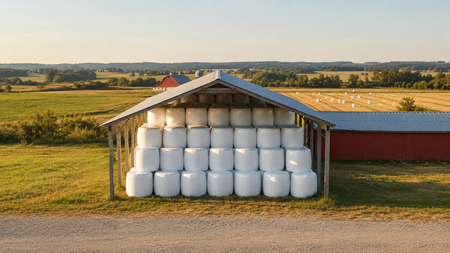
Photo by Nick Fewings on Unsplash

In Brief
- Test in the windrow before you bale, not after.
- Take readings in several spots and compare each one to the average.
- Alberta Agriculture lists 15% as optimum for large hard-core round bales and 18 to 20% for small rectangular bales.
- Bales sweat after baling. Heat usually peaks 3 to 7 days later, so check bale temperature 4 to 5 days after baling.
- Hay preservatives can allow slightly higher moisture, but they reduce heating instead of removing it.
Why Moisture Matters Before Baling
Hay keeps respiring after it is cut. Once it is baled, moulds and other microbes keep working and give off heat. Alberta Agriculture says heating occurs to some extent unless the feed is below 15% moisture. Above the safe ranges, you get excessive heating, mould growth and large losses of dry matter.
- Lost feed value: once hay reaches 55°C (131°F), browning reactions lock up protein and fibre, and the feed becomes less digestible.
- Animal health: moulds under heat stress can produce toxins that reduce intake, and their spores can cause lung problems if inhaled.
- Fire risk: heat that cannot escape a stack can lead to spontaneous combustion.
Safe Moisture Levels by Bale Type
The right target depends on bale size and density, because large bales hold heat longer than small ones. These are the ranges in Alberta Agriculture's bale moisture guide.
| Bale type | Typical weight | Safe baling moisture |
|---|---|---|
| Small rectangular | 60 lb | 18 to 20% |
| Large rectangular | 900 to 1,800 lb | 12 to 16% |
| Round, 4 x 4 to 5 x 4 ft | 500 to 1,000 lb | 15 to 18% |
| Round, 5 x 5 to 6 x 5 ft | 1,300 to 1,900 lb | 15% |
Alberta Agriculture notes that the lower end of each range suits low-humidity areas and the higher end suits other areas. For a large hard-core round bale, 15% is the number to aim for. If a reading is borderline, wait a few more hours for the hay to dry.
How to Test Hay Moisture
1. Start with the feel test
Twist a handful of hay. If it snaps or feels brittle, it may be dry. If it stays pliable or feels damp, it is not ready. Many hay producers still use this check, but it gives you no number to compare against the table above.
2. Test the windrow with a meter
Pull clumps of hay from several spots across the windrow and test each clump with a handheld meter. Compare every reading to the average. A reading far above the rest points to a wet patch. A tool like the Delmhorst F-2000 hay probe moisture tester reads from 6% to 40% moisture content, which covers everything from dry hay to wet.

Windrow testing and finished-bale testing do different jobs. Our guide to windrow vs. bale moisture testing explains when to use each.
3. Keep testing as the day goes on
Dew, humidity and wind change how fast hay dries. Retest when conditions change, and hold off baling if readings sit above your target.
4. Check a few finished bales
Short pins only read the outer layer of a bale. A longer probe gets close to the centre, where most of the problem moisture sits. Browse our hay probes and moisture testers for tools that reach into the bale.
What to Check After Baling
Many guides to testing hay moisture stop at the baler. The temperature check afterward matters just as much, because bales sweat after baling and the heat can build for days. These timings come from Alberta Agriculture's heated bales guide.
- Heat peaks about 3 to 7 days after baling, then declines over 15 to 60 days.
- Check bales 4 to 5 days after baling.
- Measure in the tightest part of the bale, 6 to 12 inches from the centre, with a thermometer that reads up to 200°F (94°C).
- Ideally, keep hay unstacked for the first three weeks.
- Bales that do not cool after the first heating cycle are a potential fire hazard.
| Bale temperature | What it means and what to do |
|---|---|
| Up to 120°F (49°C) | Not a serious quality concern. Keep monitoring. |
| 121 to 140°F (50 to 60°C) | Caution zone. Protein and fibre become less digestible. Recheck in a few hours. |
| 141 to 160°F (61 to 71°C) | Check every day at 150°F (65.5°C), and every four hours at 160°F (71°C). |
| 175°F (80°C) | Danger of fire. Check every few hours and call the fire department for advice. |
| 195°F (90.5°C) or hotter | Spontaneous combustion is possible. Do not move the hay without fire department help. |
If bales have already heated, read our guide to the signs your hay was baled too wet.
FAQ
What moisture should hay be baled at?
It depends on the bale. Alberta Agriculture lists 15% as optimum for large hard-core round bales, 12 to 16% for large rectangular bales and 18 to 20% for small rectangular bales.
Can hay be too dry to bale?
Very dry hay is safe from heating, since heating occurs to some extent unless moisture is below 15%. It can shatter and lose leaves in the field, though, which cuts feed value.
How do I test hay moisture without a meter?
Use the feel test for a quick check, or the microwave method for a number. Weigh a hay sample, dry it in short microwave bursts, and reweigh it until the weight stops dropping. The weight lost is water. Watch it closely so the hay does not scorch.
Is a moisture test the same as a feed test?
No. A meter tells you how much water is in the hay. A feed lab test measures nutrient content and can also estimate heat damage. For a lab sample, a hay core sampler pulls a core from the bale.

Can I bale wetter hay if I use a preservative?
Preservatives can allow slightly higher moisture, but they reduce heating instead of removing it. Follow the moisture limits on the product label.
In Summary
Test the windrow, aim for your bale type's number, and check bale temperature a few days later. Next, read Windrow vs. Bale Moisture Testing: When Should You Test? and Signs Your Hay Was Baled Too Wet (And How to Prevent It Next Season). To find probes and testers, browse our Hay Testing collection or call our team in Mountain View County. Testing silage instead? See our silage moisture testing tools. West Country Dairy Supply ships across Alberta and Canada.
Recent articles
View all